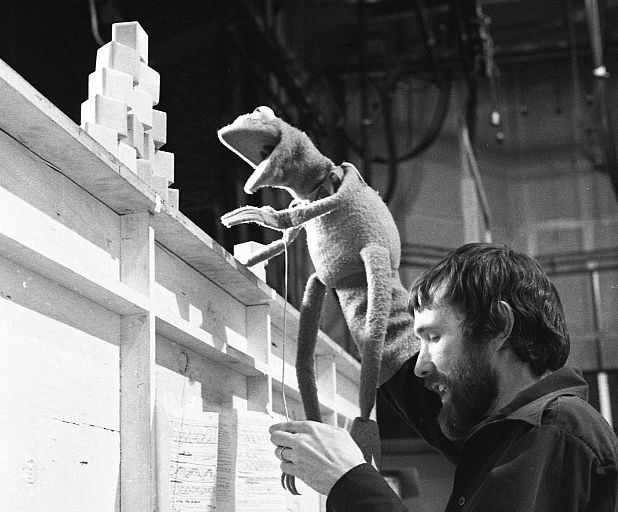
The post explores the reasons for why most of Jim Henson’s muppets are left-handers.
Browsing the catalogue of my favourite online library, I came across a book entitled Celebrated Left-Handers [1], which promised fabulous facts about these famous lefties. Curious as I am about all matters of handedness, I was intrigued and began leafing through the pages.
The book, published in 1999, was structured like a calendar. For each day of the year, it introduced a notable left-hander born on that date. There were many actors, sport stars, and various heads of various states, including a couple of U.S. presidents. I quickly realised, though, that the book was not always correct, as it featured a few – let’s say – honourable left‑handers, who almost certainly are right-handers. The then-prince-now-king Charles III of the United Kingdom, is one such example. The author apparently considered these celebrities important enough to grant them a place of honour among the genuine left‑handers.
One other of these supposed “lefties” can be found as entry on the 24th of September: Jim Henson, the American puppeteer. Should his name not immediately “ring a bell”, you will very likely recognise one or two of his creations, those anarchic characters Henson lovingly called muppets. You have likely encountered them in shows like Sesame Street or The Muppet Show. The stars of these shows, like Ernie and Bert, Kermit the Frog, or Miss Piggy, have left a lasting impression well-beyond children’s TV, and you might well have encountered them in other branches of popular culture .
Henson was, however, very likely a right-hander. He wrote and drew with his right hand and he, as you will see in a moment, controlled this puppets the way right-handers typically do. Although Henson certainly deserves to be mentioned in any book on celebrated people, the inclusion in this book on left-handers was very likely a mistake.
There were, nevertheless, a couple of lines in the paragraphs describing his work and life that caught my attention, as it suggested that one of his creations might well be a left-hander. It reads [2]:
“One of the earliest and most popular Muppets was … Kermit the Frog, who eventually became a kind of alter ego for the low‑key and essentially introverted Henson. Kermit was, like his creator, left‑handed.”
My curiosity was tickled, and I could not help but diving a bit deeper into this claim. I had to study Kermit’s handedness. So, rekindling my childhood fascination for Henson’s shows, I rewatch countless clips of Kermit acting on Sesame Street and in The Muppet Show – and indeed, it was true. Kermit clearly preferred his left hand, or whatever the frog equivalent of a hand his called by biologists. I found him holding micro- and telephones, pressing buttons, and even smashing cakes – always favouring his left hand. And during his iconic banjo routines, he strummed away with that same left hand leading the show.
And, to my surprise, Kermit was not the only leftie on the cast of these shows. Rather, most muppets seem to prefer their left hand. Bert, Ernie, the Count, Grover, Cookie Monster, Beaker, Floyd, Janice, Statler and Waldorf, all the characters I remembered from my childhood, turned out to be left-handers. Even Miss Piggy, the resident diva of the Muppet Show. You can watch her acting out her temperament, regularly hitting Kermit and other with her devastating left-hand swing.
As lively as Henson’s creations appear on screen, they are obviously just glove puppets. They are brought to live by the hands of various human puppeteers. And, it is not a very daring prediction to make that the Muppet’s left-handedness is, in one way or the other, reflecting the hand preference of these puppeteers.
So, I had to look at the puppeteers. As said, Henson was a right-hander, and so were most in his team. For example, Frank Oz, is a right-hander. He played among other the muppets Bert and Miss Piggy, and, by the way, also worked on the original Star Wars movies. Yes, in Yoda, his hand he had. And it turns out that right-handed puppeteers, like Oz and Henson, typically prefer to wear the glove puppet on their dominant right hand [3].
The picture below, which was taken at the recording of the Sesame Street, nicely illustrates this. On the left, you can see Frank Oz controlling Bert, the yellow fellow, who is a type of a glove-and-rod puppet. The glove part is the head of Bert, which is here operated by Oz with his right hand stuck in the puppet’s back. This leaves Oz’s left hand free to operate the rods or sticks controlling the hand and arm movements of the puppet. As Bert’s left hand is closer to Oz’s free left hand, Oz naturally prefers to use the left hand of Bert when interacting with the props or when gesticulating, making Bert appear to be a left-hander.
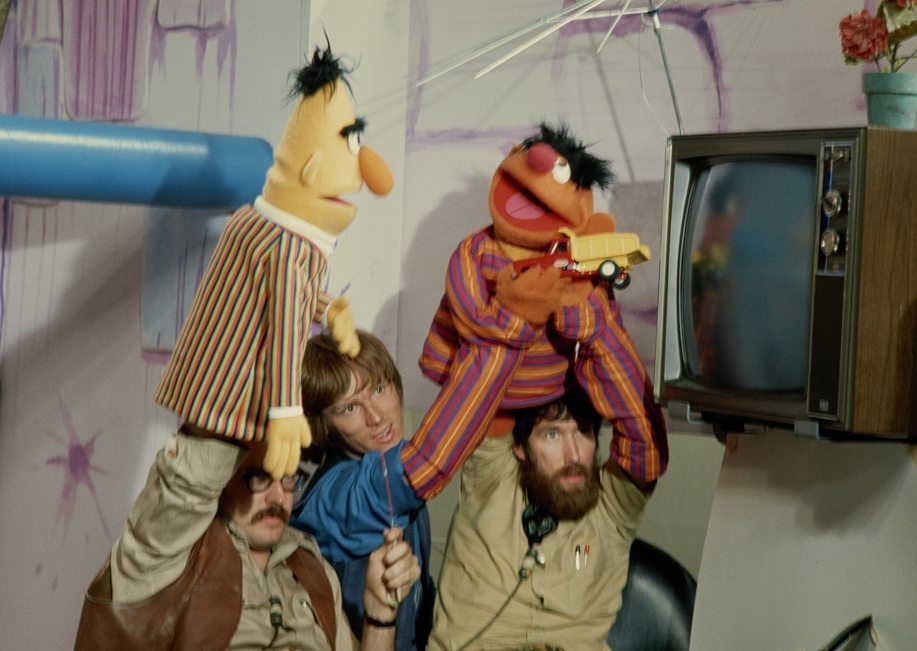
Similarly, on the right side, we see Jim Henson controlling Ernie, the orange chap. Ernie is a slightly different type of puppet than Bert as his hands are not controlled by rods. Rather he is a live-hand puppet, and has two gloves as hands, significantly increasing his manual dexterity compared with Bert, but also, as seen in the picture, requiring a second puppeteer when actions of both hands are required. So, Henson controls Ernie’s head with his right hand, while wearing a second glove representing the muppet’s left hand on his own left hand. Ernie’s right hand, in turn, is controlled by the second puppeteer wearing the glove – a process fittingly called right handing in the trade – which here is done by Daniel Seagren. Nevertheless, since Henson is the lead puppeteer of Ernie, it will naturally be him who leads the manual acting with his and Ernie’s left hand.
So, it appears, Henson’s muppets – and likely most other glove puppets – end up as left-handers simply because the nervous systems controlling them are usually right-handers. Right-handed puppeteers animate left-handed puppets.
Of course, not all people are right-handed, and the occasional left-handed puppeteer should animate right‑handed puppets. And, indeed, this seems to be the case. Louise Gold was one such puppeteer on The Muppet Show. She played various characters including the recurring Annie Sue – Miss Piggy’s younger pig rival. Gold used her left hand to control Annie Sue’s head and her right hand to guide the arm rods. Annie Sue accordingly turned out to be a right-handed muppet.
These observations enable us to speculate about the handedness of the muppets and puppets seen as a population. About 10% of the human population are left-handers [4], and there is no reason to doubt that puppeteers are somewhat representative for this population and exhibit a similar incidence rate of left handedness. The muppets controlled by these left-handers will likely appear right-handed, while the other 90% will typically turn out to be left-handed. In other words, in muppets right-handers are probably as infrequent as left-handers are among us humans.
Henson’s muppets, as most other puppets, are caricatures, accentuating our human quirks, anxieties, and peculiarities in their acting. Watching their shows, offers us a mirror, in which we can recognise ourselves or people we know. And, as for any proper mirror, left and right are also confused here, and most puppets appear left-handers.
[1] Rutledge, L. W. (1999). Celebrated left-handers: Fabulous facts about famous southpaws. NY: MJF Books. [https://archive.org/details/celebratedleftha00]
[2] Ibid, p. 214
[3] Freeman, S. (2007). How Muppets Work, HowStuffWorks.com. Retrieved 6. April 2026 [https://entertainment.howstuffworks.com/muppet.htm; archived here]
[4] Papadatou-Pastou, M. et al. (2020). Human handedness: A meta-analysis. Psychol. Bulletin, 146, 481-524. https://doi.org/10.1037/bul0000229