Based on historic documents and recently published survey data, the post explores the history of the retraining of left-handers in Germany during the 20th century.
Whenever I read about the retraining of left-handers, I am transported back to this one episode from my childhood. Sitting at the kitchen table at my grandparents’ house, I was busying myself by with a colouring book. I must have been only about three years old, but I remember how my grandmother joined me. Sitting down next to me in her light blue apron, she gently instructed me with a “use your nice hand!”, as I, according to her opinion, was holding the crayons in the wrong, left hand [1].
There was no explanation for why the right hand was deemed “nicer”, and had I asked her for a reason, she likely would have shrugged. For her generation, born and raised in rural Germany in the 1920s, it was just obvious that writing or drawing had to be done with the right hand.
The practise of training left-handed children to write with their right hand, arguably, has a long tradition in Germany [2], like it has in most, if not all, other countries. Caregivers at home or teachers at school would instruct children, sometimes even using rather ungentle measures, to use their right hand. The personal accounts of many “first-hand victims” of this strange practise can easily be found in the various online forums dedicated to the topic [3]. And whenever you find a SoMe post concerning left handedness, you can be almost certain to also find comments below it that report such retraining experience. Yet, as the saying goes, times change, and this practice – while not complete overcome – has gone increasingly out of fashion. The continuously rising number of left-handers across the globe can be seen as evidence for this development [4].
While handedness retraining in Germany is well-documented by countless anecdotal reports, it is much more difficult to find reliable information on how frequent it actual was, or until when exactly it was systematically practised. A bit of “snooping” through publicly available political and pedagogical archives [5] reveals that handedness – or its retraining – only very rarely appears as a concern in these texts. And where it does, it is promoting tolerance of left-handed writing rather than the opposite. I was not able to find a single serious document instructing pedagogues to retrain their left-handed students.
For example, already in 1920, the Minster for Education of Prussia, Konrad Haenisch, explicitly advised teachers in the states’ schools to allow left-handed writing [6]. He ordered that, after carefully confirming a student’s left handedness, it should be left up to the student’s own choice whether they prefer to write with their left or right hand. Or, to quote the German original:
“[Es] ist den Schülern freizustellen, ob sie beim Schreiben von der linken oder rechten Hand Gebrauch machen wollen.”
Such a progressive policy in the by far largest federal state of the young German republic could be predicted to have a huge impact, potentially leading to a significant increase in left-handed writers in subsequent generations. However, the available data does not really support this expectation. Instead, it did not have any measurable immediate effect.
This conclusion is based on a recent study on this topic [7], which analysed data from a representative survey on the economic situation of German households, incorporating handedness information from approximately 13,000 men and women born between 1920 and 1997. Recognising that overall handedness and writing hand are not necessarily the same, the designers of the survey had included the two simple handedness questions: “Are you a natural right- or left-hander?” and “With which hand do you actually write?“
The graph below shows how the participants of the study answered these questions by featuring two key plots. The first, represented by the bold solid line at the top, shows the proportion of participants from each birth cohort who identify as “natural left-handers.” The second – the bold dashed line – shows the proportion of participants who actually write with their left hand.
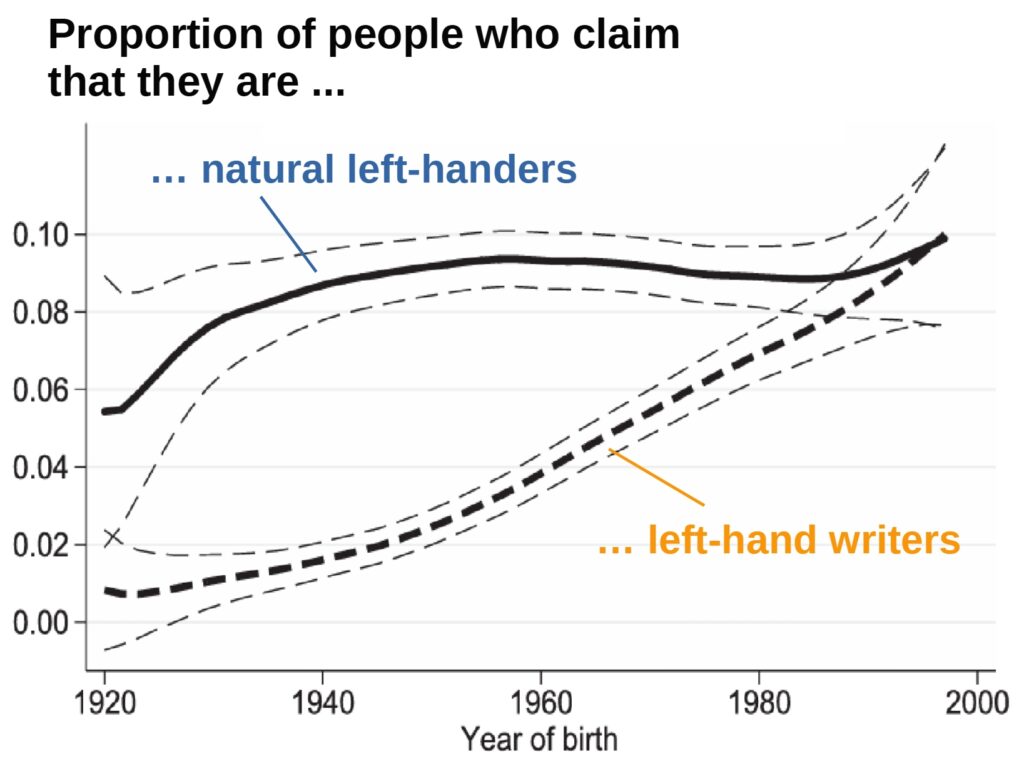
If there had been no retraining at all, all natural left-handers would also write with their left hand. That is, we would expect the two plots to overlap almost entirely. As can be seen, however, this is not the case for most of the cohorts. There is a significant gap between the two lines, which persists until the 1990s. So, it appears that until then, handedness retraining was practised in Germany, if not nationwide so at least in a few classrooms or around some kitchen tables.
The proportion of left-handed writers did, however, steadily increase across the generations, with a noticeable acceleration starting with those cohorts born from around the 1960s. As a result, the “retraining gap” between the two curves was successively closing. Eyeballing the graph, one can also guess that from the 1970s cohorts onwards less than 50% of the left-handers experienced retraining attempts of lasting “success”, while this number seems below 25% for those born in the 1980s.
Interesting is also what this graph does not show. There are no noticeable dips or bumps in the curve representing the proportion of left-handed writers. For example, the aforementioned 1920 directive by the Prussian Ministry of Education – allowing students to write with their left hand – did not result in the expected increase in left-handed writing rates. Also, other historical changes in German government with their dramatic shifts in political ideology, seem not have left a noticeable mark in these curves.
Taken together, it has taken Germany at least 70 years – from the first federal state endorsing left-handed writing in schools to a virtually stop of the practise of retraining in the 1990s. It was a slow but steady societal shift toward greater tolerance of left-handedness rather than a sudden jump caused by political decisions. Of note, the members of Gen Z might well be the first Germans not to learn from others which of their two hands is supposed to be the “nicer” one.
[1] I am not sure what effect this and similar episodes had on my own hand preference. Likely none, as I am strongly right handed today, and I am quite certain that I also without this early intervention by my grandmother would have turned out be a boring right-hander.
[2] see also evidence from the 19th century, shown here: https://westerhausen.dk/retraining-of-left-handers-evidence-from-a-mid-19th-century-caricature/
[3] Take, for example, the subreddit on handedness: https://www.reddit.com/r/handedness/
[4] McManus, I. C., Moore, J., Freegard, M., & Rawles, R. (2010). Science in the Making: Right Hand, Left Hand. III: Estimating historical rates of left-handedness. Laterality, 15(1-2), 186-208. https://doi.org/10.1080/13576500802565313
[5] one excellent source is https://scripta.bbf.dipf.de/viewer/index/
[6] It is a directive targeted at regional school administrations; published on page 322-323 in: Ministerium für Wissenschaft, Kunst und Volksbildung (1920). Zentralblatt für die gesamte Unterrichtsverwaltung in Preußen. Weidmannsche Buchhandlung, Berlin
[7] Guber, R. (2019). Making it right? Social norms, handwriting and human capital. Labour Economics, 56, 44-57. https://doi.org/10.1016/j.labeco.2018.11.005