
Inspired by the case of the British journalist Douglas Macdonald Hastings, the post explores the phenomenon of left-right confusion in left-handers.
Douglas Macdonald Hastings (1909 – 1982)[1] was a British author, television broadcaster, and journalist. He became known to a wider UK audience through his World War II reporting for the Picture Post magazine, accompanying the troops during their campaign to liberate France. In the end of the 1950s, he also was a familiar face on the BBC programme Tonight, and over the course of his career he authored numerous books, including several detective novels.
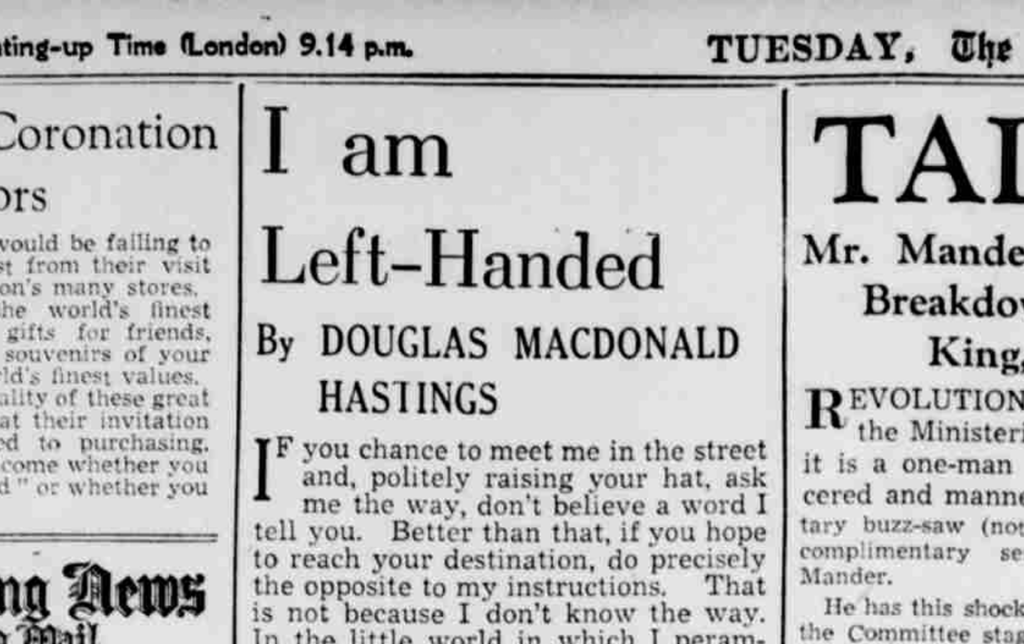
According to piece he published in the London Newspaper The Evening News in April 1937, he also was a left-hander [2].
In this rather intriguing article, Hastings offers a glimpse into the life of a left-hander born in the early 20th century UK. He complains that the society he is living in, is biased against left-handers. In a world dominated by right-handers, left-handedness is considered a significant flaw:
“Just because right is might, anybody that isn’t right must be wrong”.
He recalls that he had been made to write with his right hand in school, against his innate inclination to draw and paint with his left hand. A common practise in schools of that time. But he also reports that these challenges did not stop with childhood. He describes the concerned look on the faces of his right-handed friends that appeared whenever he picked up a knife with his left hand to slice bread. These looks were often accompanied by well-meant comments that, however, unmasked the latent prejudices his friends held against him as a left-hander:
“it is certain that someone will warn me to be careful not to cut myself”
Surprisingly, however, Hastings himself appears not to be entirely free from such stereotypes. He starts the article with a strong warning about his ability to give directions, a deficit, which he directly attributes to his left handedness. It reads:
“If you chance to meet me in the street and, politely raising your hat, ask me the way, don’t believe a word I tell you. Better than that, if you hope to reach your destination, do precisely the opposite to my instructions. That is not because I don’t know the way […] Neither am I of an anti-social disposition. It is simply that I am unable to distinguish between left and right. I am left-handed.”
The phenomenon he describes is known as left-right confusion. It refers to a person’s difficulty in reliably and rapidly distinguishing left from right – whether on one’s own body or in external space, as for example, when giving directions. The reasons for suffering from this phenomenon are not known, but it is typically not tied to any medical condition. What is known, however, is that left-right confusion is remarkably common. Recent studies estimate that approximately 15% of the general population experience it regularly [3].
Supporting Hastings’ suspicion, some studies did indeed suggest that left‑handers experience left-right confusion more often than right‑handers. However, these earlier findings have not consistently been replicated, and modern accounts typically contradict the notion of a meaningful difference between left- and right-handers.
One recent example is a study by Hikari Yamashita conducted at the University of Osaka, Japan [4]. He tested each 64 left‑ and right‑handers in a map-navigation task. Participants were asked to follow a predefined route on a map placed in front of them and, at each of 32 turning points, they had to state whether a “left” or “right” turn was required. Left- and right-handers showed comparable performance: both the number of errors and the total time needed to complete the route were similar.
So, Hastings was likely wrong in blaming his left-handedness for the left-right confusion. It appears more plausible that he, by mere chance, had been a member of two minorities: the 10% of the population that are left-handers, and the 15% of population that mix left and right. It was a coincidence, not a causal relation in any direction.
Should you, like Hastings, often find yourself confusing left and right, he also offers a memory hook to help in such situations. Follow your heart! It usually beats on the left side of the body. Unless, of course, you happen to have an extremely rare condition called situs inversus [5], in which case the logic is naturally reversed. But that is a different story altogether.
[1] https://en.wikipedia.org/wiki/Macdonald_Hastings
[2] Macdonald Hastings, D. (April 27th, 1937). I am Left-Handed. The Evening News . Retrieved from https://www.britishnewspaperarchive.co.uk/
[3] van der Ham, I. J., Dijkerman, H. C., & van Stralen, H. E. (2021). Distinguishing left from right: A large-scale investigation of left–right confusion in healthy individuals. Quarterly Journal of Experimental Psychology, 74(3), 497-509. https://doi.org/10.1177/1747021820968519
[4] Yamashita, H. (2022). Investigating individual differences in left-right confusion among healthy Japanese young adults. Culture and Brain, 10(Suppl 1), 49-64. https://doi.org/10.1007/s40167-022-00112-5
[5] https://en.wikipedia.org/wiki/Situs_inversus