Tag: handedness myth

  • Handedness of Acclaimed Architects: Are Left-Handers More Talented?

    Handedness of Acclaimed Architects: Are Left-Handers More Talented?


    By examining the handedness of acclaimed architects the post explores the popular belief that left-handers posses a greater artistic talent than right-handers.


    Reading popular‑science articles, blog posts, or online discussions about left‑handedness, one regularly comes across the claim that left‑handers possess a special talent for artistic expression. Ask your favourite generative‑AI chatbot, and you will readily be informed that left‑handers are thought to be over‑proportionally often found in the “creative fields” including visual art, music, or writing [1]. You might even get offered a list of names of supposed left-handed artists as examples for this creative left-handedness, with the likes of Leonardo da Vinci, Pablo Picasso, Vincent van Gogh, Jimi Hendrix, or Lady Gaga, topping that list [2].

    While it is not entirely clear where this popular belief in “creative left-handers” originated, one root appears to stretch back to a series of studies examining the handedness of architects. Conducted in the 1970s and led by John Peterson, these studies reported that left-handers were surprisingly common at the Department of Architecture at the University of Cincinnati [3]. Instead of the roughly 10% prevalence expected in the general population, about 29% of the academic staff and 16% of the school’s students were reported to be left-handers. Even more intriguingly, the left-handed students were also more successful. The rate of graduation was about 10% points higher in left-handers than in their right-handed peers.

    It is not really surprising that these astonishingly clear findings were taken as evidence for a special talent for architecture among left‑handers. Peterson’s observations were accordingly cited as a key evidence for the formulation of a general theory about human brain development [4]. It was argued that both being left‑handed and having a strong visual‑constructive imagination were the result of an accentuated maturation of the brain’s right hemisphere. This maturation, in turn, was hypothesised to be driven by unusually high prenatal levels of the hormone testosterone.

    The validity of this theory has been seriously questioned ever since its conception. Yet, it offers a good story which at the time made it a quite influential theory. So, it is not unlikely that it helped cementing the idea of “creative left handedness” both in the heads of many scientists and, via journalists, also in the public mind.

    Considering the handedness of architects, it must be noted, however, that most later studies that attempted to replicate Peterson’s findings failed to do so. And, when I first started looking into the topic early last year, the idea of an excess of left-handed architects was already standing on quite shaky fundaments. Nevertheless, curious, as I was, I decided to have another look at it and I set out to find left-handers among famous architects. I thought if left-handers were indeed predestined to pursue a career in architecture, they should be particularly well represented among the men and women who have left a lasting mark on our cities.

    The very first name I typed into “google” was Sir Norman Foster, the British star architect. Even if you are not familiar with his name, I am certain you have come across one or two of his buildings. The Millennium Bridge in London, the renovated Reichstag with its modern glass dome in Berlin, or the 2 World Trade Center in New York, are some of the more famous examples. When watching the first documentary I found about him [5], it became quickly obvious – literally within the first shots – that Foster was sketching his ideas holding the pen in his left hand. And, after consulting some more online material, I was quite convinced, he was, in fact, a left-hander.

    Spurred on by this surprisingly quick success, I typed in some other names that came to mind, and I soon landed on the Swiss architect duo Herzog and de Meuron, the minds behind the Elbphilharmonie in Hamburg orThe Bird’s Nest, the stadion built for the 2008 Summer Olympics in Beijing. While one, Jacques Herzog, was clearly right-handed, the other, Pierre de Meuron, was writing and cutting ribbons with his left hand. Bingo! Another left-hander among the famous architects!

    It was at this point that I decided to approach my hunt for left-handed architects a bit more systemically. Rather than randomly picking the names of architects that popped to my mind – a source which I was aware would soon run dry – I decided to go into the winner lists of various prestigious architecture awards. I started with the Pritzker Architecture prize, which is sometimes referred to as the “Nobel prize for architecture”, but soon went on to include other national and international awards and prizes in my search for relevant names.

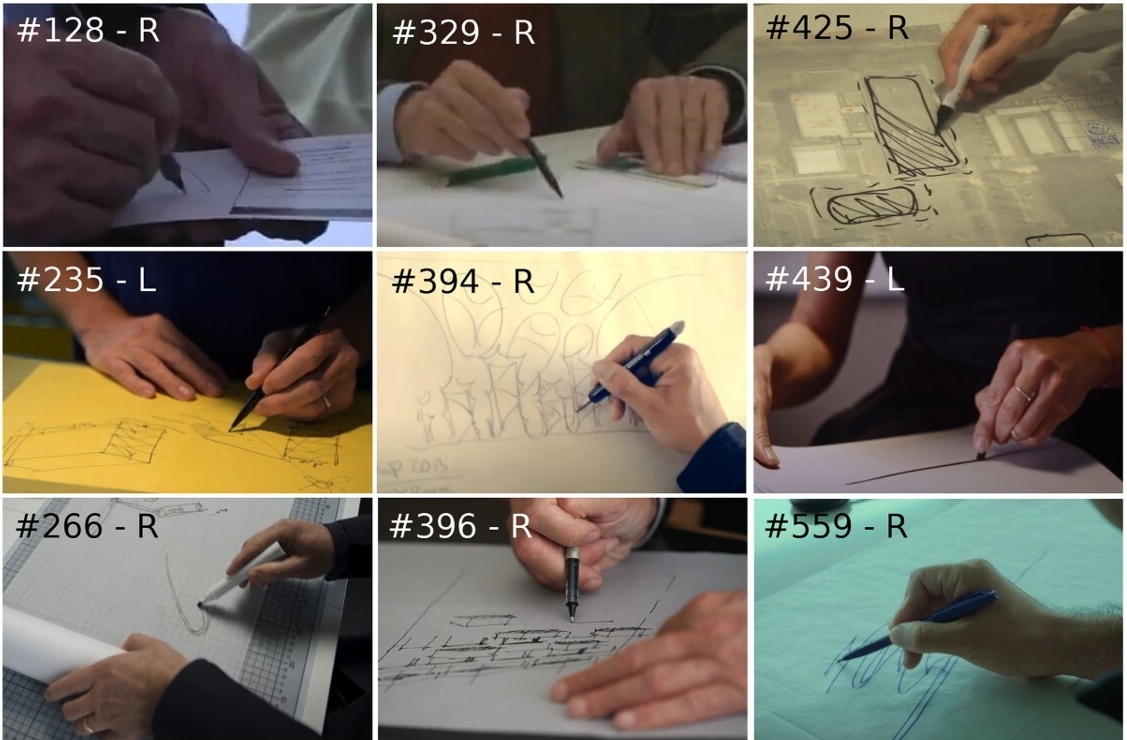
    Armed with a set of winners list I began scouring the internet for videos and pictures showing the various architects while they were writing, sketching, or drawing, so I could determine their handedness. And about 600 architects later, I crunched the numbers. Here is what I found [6]:

    Only 8% of the architects were left‑handers (or ambidextrous) which was below rather than above the 10% one would expect in the general population. In other words, left-handed architects, like Foster and de Meuron, were not more common than expected.

    However, many of the architects on the winners lists had been born and grown up in times in which left-handers were subject to retraining. So, it was not possible to exclude that some members of my sample had been taught, against their inborn preference for the left hand, to write – and maybe also sketch – with their right hand. Ignoring this historical trend would obviously result in an underestimation of the amount of true left-handers in my sample. I had to make sure that this was not the case.

    Since the 1950s retraining has gone increasingly out of fashion[7] and by selectively excluding architects born before 1950, it was possible to minimise the effect of retraining on my results. And, doing so, the incidence of left-handedness was indeed increased in this younger cohort. Nevertheless, the corrected rate of 10% did not differ statistically from the expected population rate. Left-handers were also not unusually frequent among the younger architects.

    In short, it appears that Peterson’s results stand out as an exception. Being a left-hander instead of a right-hander does not really increase the likelihood for becoming a succesful architect.

    Coming back to the common belief in the creative left‑hander, the finding chips away one likely root for this belief, while adding to a growing body of evidence disproving it [8]. Also outside architecture, left‑handers, seen as a group, are neither more creative than right‑handers nor over‑represented in professions commonly considered “creative”. That is, left-handers are likely as talented as right-handers to pursue a career in visual arts, music, design, writing, or architecture.


    [1] Porac, C. (2025). ChatGPT: Tell me what you know about left-handedness. Retrieved August 11, 2025, from, https://sites.psu.edu/clarep/2025/01/17/chatgpt-tell-me-what-you-know-about-left-handedness/

    [2] It can be questioned whether Pablo Picasso or Vincent van Gogh actually were left-handers at all. Both likely painted with their right hand. See Lanthony, P. (1995). Left-handed painters. Revue Neurologique151(3), 165–170, and in case of Picasso, video evidence for this is readily available online

    [3] Peterson, J. M., & Lansky, L. M. (1974). Left-handedness among architects: Some facts and speculation. Perceptual and Motor Skills38(2), 547–550. https://doi.org/10.2466/pms.1974.38.2.547; and Peterson, J. M., & Lansky, L. M. (1977). Left-handedness among architects: Partial replication and some new data. Perceptual and Motor Skills45(3), 1216–1218. https://doi.org/10.2466/pms.1977.45.3f.1216

    [4] Known as the Geschwind-Galaburda theory, which can be found on wikipedia.org: https://en.wikipedia.org/wiki/Geschwind-Galaburda_hypothesis

    [5] Norman Foster: Striving for Simplicity, 2015, Louisiana Channel, https://youtu.be/hJNxgv9Rak0

    [6] Westerhausen, R. (2025). Handedness of acclaimed architects: No indication for an over-proportional representation of non-right handers. Laterality, 30(2-6), 220-234. https://doi.org/10.1080/1357650X.2025.2569374

    [7] McManus, I. C., Moore, J., Freegard, M., & Rawles, R. (2010). Science in the making: Right hand, left hand. III: Estimating historical rates of left-handedness. Laterality15(1-2), 186–208. https://doi.org/10.1080/13576500802565313; see also previous posts on retraining

    [8] Meta-analysis by Morgan, O., Zhao, S., & Casasanto, D. (2025). Handedness and creativity: Facts and fictions. Psychonomic Bulletin & Review, 1–35. doi:10.3758/s13423-025-02717-2; or see: Røsvoll, Å., Rusten, E. H., & Westerhausen, R. (2024). Left-hand preference in visual artists: a pre-registered observational study on Instagram. Laterality29(2), 184-198.  https://doi.org/10.1080/1357650X.2024.2315856 or post here
  • The Irrational Fear of Left‑Handed Barbers

    The Irrational Fear of Left‑Handed Barbers


    Historic UK newspapers reveal how left‑handed barbers and left-handed hairdressers struggled for acceptance within their trade.


    Mirror, mirror, on the wall. Here I was again, staring at my wet-haired mirror image. My hairdresser had started his work, clipping away, hopefully following my earlier instructions. The necessary small-talk had started – how was holiday? the children? – but soon it had ebbed down again, and only the regular sound of the rapid snip-snip-snip of his scissors could be heard. Again and again, he gathered a small tuft of hair between his fingers before cutting it down to size. Watching this ritual a few rounds, it suddenly struck me: he was holding the scissors in his left hand. Was he left‑hander?

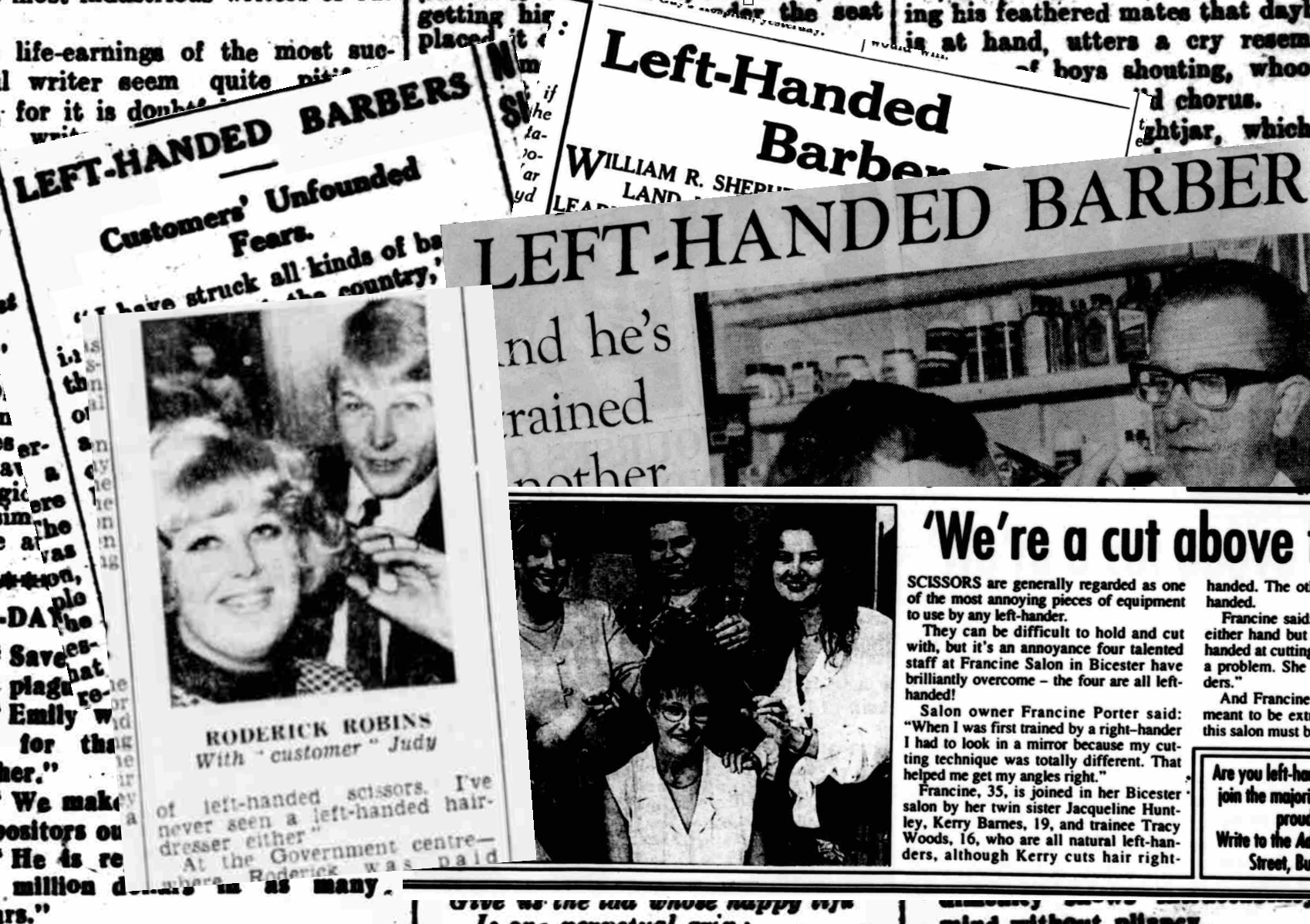
    During one of my recent recreational excursions into online newspaper archives, I had stumbled upon a series of articles about left‑handed hairdressers and left‑handed barbers published in UK newspapers. Spanning more than seven decades, these pieces viewed together, offered a striking illustration of how attitudes toward left‑handers have shifted over time. I learned about the prejudice left‑handed hairdressers once faced and the societal obstacles they had to overcome in pursuing their passion for their trade.

    The most telling article I found, was the one published in the London-based Pall Mall Gazette in November 1922 [1]. It claimed that many men were afraid of being shaved by left‑handed barbers. As evidence of this sentiment, the article presented an anonymous travelling salesman who, through his work, had encountered countless barbers across the country. The man admitted that he always felt uneasy when assigned to one who was left‑handed. He even confessed to fearing for his life, as though he were placing himself before a double-sinister version of Sweeney Todd [2], and revealed that he would even flee the barber’s chair without a shave whenever he realised he was in the hands of a left‑handed barber:

    Of course, it is foolish, but … I leave the shop on some pretext or other and go elsewhere to be beautified.

    The man’s fear is obviously the result of deeply-rooted prejudice, portraying left‑handers as clumsy and prone to accidents. This scientifically disputed stereotype did not only lead to fleeing customers and other awkward social situations. Apparently, it also manifested itself in the exclusion of left‑handers from certain professions, including hairdressing, as a series of newspaper articles from early 1938 vividly illustrates [3].

    In a story unfolding across a couple of weeks, we learn about the case of William R. Shephard, a workless 24-year old from Sunderland, whose dream it was to pursue a career as hairdresser and barber. Accordingly he applied at his local UK government training centre, which at the time provided vocational training to unemployed youth, like him. The training centre, however, did refuse to take him up in the hairdresser programme. Referring to his left-handedness, they rejected his application. As William described it:

    “When I was interviewed by members of the panel at the centre … it came out that I was left-handed, and they turned me down.”

    Published in the politically left-leaning Daily Herold, the fate of the young man caused a “chorus of protests”. Several outraged left‑handed barbers wrote letters in his support, expressing that they failed to see any reason for banning William from the training programme. It even triggered some deeper journalistic investigations. The training centre was contacted by an unnamed journalist which led to the discovery that the Ministry of Labour had blacklisted left-handers from learning certain professions. Plasters, carpenters, tile fixers, wood-machinists, coach-body builders, sheet-metal workers, and also barbers and hairdressers were supposed to be right handed. Left-handers were barred from these jobs, just because of their handedness.

    In the “best” case, this list had been compiled with safety issues in mind and it is not just an expression of prevailing anti-leftie stereotypes. The relevant tools and machines might not have been built to be safely operated with the left hand. But did this concern also apply for hairdressers and barbers? Possible problems with the scissors and shears that are usually made for right-handers?

    This seems not to be the case, at least if we believe the words of an also interviewed hairdresser. As he put it, the tools of the trade are – at least with training – usable also with the left hand, and:

    “A man who is naturally and actively left-handed should not find it a bar to hairdressing.”

    Unfortunately, the articles do not reveal whether the protests actually had made a difference for young William. The general policy of excluding left-handers from hairdressing training, appears not have changed for a while, however, as an article from 1947 suggests [4].

    Published in the Liverpool Daily Post, the piece informs us that a training centre – this time located in Aintree, North of Liverpool – was about to start a new women’s hairdressing course, and that one of the required qualifications was for the trainees to be right-handed. The journalist, a Jean Johnson, asked the centre for the reason behind this requirement, and got the following answer:

    “Think of the alarm … which would attack a customer if he saw a left-handed barber coming at him with a razor”

    Together with the journalist, we are left wondering what this argument has to do with women’s hairdressing. It appears, the prevailing prejudices were considered sufficient explanation by the training centre, while any good argument for excluding left‑handers was simply missing. Although not stated explicitly, one can speculate that the list barring left‑handers from the trade was still somewhat guiding the centre’s decisions. Yet rejecting left‑handed applicants at a government‑run training centre, without any comprehensible reason, could well be regarded as a form of institutionalised discrimination.

    Luckily, times change, and forwarding history by about 20 years, there is evidence that the training centres’ policy had finally been adjusted. In an issue of the Daily Express from 1968, we are introduced to Roderick Robins from Swindon [5]. He was a young aspiring hairdresser, who had recently finished his education as hairdresser in a training centre in Bristol. The centre, according to a spokes person, had only recently accepter left-handers as hairdressers. And, they even had equipped Roderick with two pairs of true left-handed scissors.

    So, one would have hoped, Roderick’s career as left-handed hairdresser was off to a good start. But that was unfortunately not the case. Although he was well-trained and had passed his final examination with success, no hair salon was willing to employ him because – you guessed it – of his left-handedness. He is quoted complaining:

    “Hairdresser still treat left-handers and left-handed scissors as a joke … One man hired me on a week’s trial. Then he said there was no such thing as a left-handed hairdresser.”

    Again, the article does not provide any clue about the fate of Roderick and his career. But we learn, that at least his “blonde girl-friend Judy,” happily volunteered as his customer (as seen in the feature image above).

    In any case, Roderick’s story shows that in 1968 left‑handed barbers or hairdresser still were even more exceptional than left-handedness itself. In yet another article from the same year and published in The Derby Evening Telegraph, we even get a description of exactly how rare left‑handed barbers were at the time [6]:

    “Like straight bananas, pink elephants and de Gaulle saying ‘Oui’ instead of ‘Non,’ the species [left‑handed barbers] would appear to be something of a myth”

    The article does not fail, however, to present such a mythical creature to the reader. It is named Mr. Alfred Martin, a left-handed hairdresser who ran his own salon in a small town close to Nottingham, and who, according to his own assurance, never really had any problems with his handedness. I am not sure how poor William and Roderick might have felt reading this statement.

    The final article I discovered on the topic is from 1996. In honour of the in the meantime introduced and celebrated Left-Handers Day, the Bicester Review ran a story about the hairdresser parlour Francine Salon [7]. We are told that the staff of this salon consisted of a crew of four talented hairdressers – the owner Francine Porter, her twin sister Jacqueline Huntley, a Kerry Barnes, and trainee Tracy Woods – all four of them left-handers! What are the odds?!

    The article shows the hairdresser quartet smiling cheerfully at the camera (see cover picture above), and it is clearly meant as a light‑hearted piece to entertain the newspaper’s readers. Notably, it is the first article in my modest collection that does not invoke any prejudices about left‑handers or mention discrimination of any kind. The public attitude toward left‑handedness seem to have changed, and the narrative is no longer focussing on the negative stereotypes. Left-handedness does no longer really matter. Well, at least not to right-handers.

    The practical everyday challenges of being a left-hander in a right-handed world do still remain. Francine offered a small glimpse into these challenges, recalling what she encountered at the beginning of her own career. She is quoted:

    “When I was trained by a right-hander I had to look in a mirror … That helped me get my angles right.”

    Manual skills, like making knots or using tools and scissors, are learned faster when the person demonstrating it – the model – has the same hand preference as the learner [8]. Observing the model in the mirror, and virtually reversing the model’s hand preference, sound like a viable strategy to improve learning the tricks of the trade.

    Talking about mirrors “switching” handedness brings me back to my own hairdresser in the year 2026. I was just about to ask him about his experiences as a left‑handed hairdresser. Had he faced any challenges during his training? Had he ever encountered discrimination because of his handedness? But before opening my mouth, I decided to double‑check what I thought I had seen.

    After engaging in an embarrassingly long struggle with the confusing nature of mirrors, I had to revise my initial conclusion. He was, in fact, operating the scissors with his right hand, after all. Not that it really mattered, of course, but still I felt a small sting of disappointment. He was just an ordinary right‑hander – just like myself.


    [1] “Left-handed Barbers”, Pall Mall Gazette, Thursday, November 2nd, 1922, p. 10, Retrieved from https://www.britishnewspaperarchive.co.uk/

    [2] For a matter of completeness, the fictional Demon Barber of Fleet Street was sinister only in his deeds, not in his handedness. In the original illustrations from 1846/1850 he was depicted right-handed, and in Stephen Sondheim’s musical adaptation from 1979, Todd is supposed to say “My right arm is complete again” when holding up the razor-come-weapon in his stretched out right hand.

    [3] “Left-handed Barber Ban”, Daily Herald, Monday, January 24th, 1938, p. 9; “Left-handed Barbers”, Daily Herald, Tuesday, February 1st, 1938, p. 3; “Left-handed Barber. Training Centre’s Ban – and Why”, The Journal, Wednesday, February 2nd, 1938, p. 9; All retrieved from https://www.britishnewspaperarchive.co.uk/

    [4] Jean Johnson, “Keeps You Posted”, Liverpool Daily Post, Saturday, May 10th, 1947, p.4, Retrieved from https://www.britishnewspaperarchive.co.uk/

    [5] John King, “Roderick and His Southpaw Scissors”, Daily Express, March 6th, 1968, p. 1, Retrieved from https://www.britishnewspaperarchive.co.uk/

    [6] “Left-handed Barber. Not quite a myth but certainly a great rarity”, Derby Evening Telegraph, Thursday, March 14, 1968, p. 6, Retrieved from https://www.britishnewspaperarchive.co.uk/

    [7] “We Are a Cut Above the Rest”, Bicester Review, August 23rd, 1996, p.21, Retrieved from https://www.britishnewspaperarchive.co.uk/

    [8] Zickert, N., Geuze, R. H., Riedstra, B., & Groothuis, T. G. (2021). Is imitational learning a driving factor for the population bias in human hand preference? Journal of Human Evolution, 159, 103045. https://doi.org/10.1016/j.jhevol.2021.103045

  • Left-Right Confusion in Left-handers: The Case of Mr. Macdonald Hastings

    Left-Right Confusion in Left-handers: The Case of Mr. Macdonald Hastings


    Inspired by the case of the British journalist Douglas Macdonald Hastings, the post explores the phenomenon of left-right confusion in left-handers.


    Douglas Macdonald Hastings (1909 – 1982)[1] was a British author, television broadcaster, and journalist. He became known to a wider UK audience through his World War II reporting for the Picture Post magazine, accompanying the troops during their campaign to liberate France. In the end of the 1950s, he also was a familiar face on the BBC programme Tonight, and over the course of his career he authored numerous books, including several detective novels.

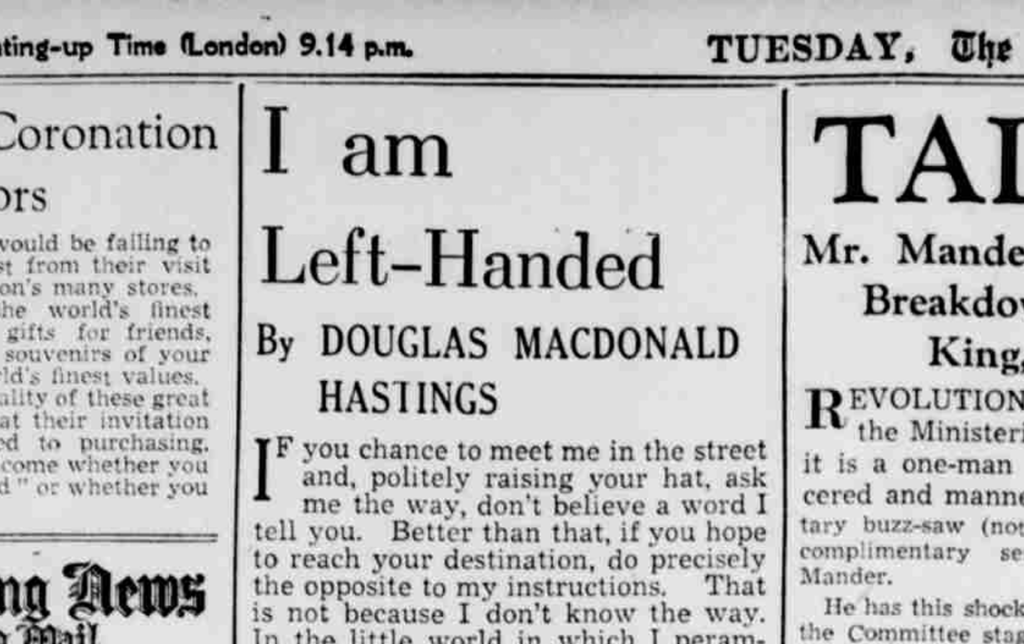
    According to piece he published in the London Newspaper The Evening News in April 1937, he also was a left-hander [2].

    In this rather intriguing article, Hastings offers a glimpse into the life of a left-hander born in the early 20th century UK. He complains that the society he is living in, is biased against left-handers. In a world dominated by right-handers, left-handedness is considered a significant flaw:

    Screenshot of the article title
    Titel of Mcdonald Hastings article, published in The Evening News, April 27th, 1937. (source: https://www.britishnewspaperarchive.co.uk/)

    Just because right is might, anybody that isn’t right must be wrong”.

    He recalls that he had been made to write with his right hand in school, against his innate inclination to draw and paint with his left hand. A common practise in schools of that time. But he also reports that these challenges did not stop with childhood. He describes the concerned look on the faces of his right-handed friends that appeared whenever he picked up a knife with his left hand to slice bread. These looks were often accompanied by well-meant comments that, however, unmasked the latent prejudices his friends held against him as a left-hander:

    it is certain that someone will warn me to be careful not to cut myself

    Surprisingly, however, Hastings himself appears not to be entirely free from such stereotypes. He starts the article with a strong warning about his ability to give directions, a deficit, which he directly attributes to his left handedness. It reads:

    If you chance to meet me in the street and, politely raising your hat, ask me the way, don’t believe a word I tell you. Better than that, if you hope to reach your destination, do precisely the opposite to my instructions. That is not because I don’t know the way […] Neither am I of an anti-social disposition. It is simply that I am unable to distinguish between left and right. I am left-handed.

    The phenomenon he describes is known as left-right confusion. It refers to a person’s difficulty in reliably and rapidly distinguishing left from right – whether on one’s own body or in external space, as for example, when giving directions. The reasons for suffering from this phenomenon are not known, but it is typically not tied to any medical condition. What is known, however, is that left-right confusion is remarkably common. Recent studies estimate that approximately 15% of the general population experience it regularly [3].

    Supporting Hastings’ suspicion, some studies did indeed suggest that left‑handers experience left-right confusion more often than right‑handers. However, these earlier findings have not consistently been replicated, and modern accounts typically contradict the notion of a meaningful difference between left- and right-handers.

    One recent example is a study by Hikari Yamashita conducted at the University of Osaka, Japan [4]. He tested each 64 left‑ and right‑handers in a map-navigation task. Participants were asked to follow a predefined route on a map placed in front of them and, at each of 32 turning points, they had to state whether a “left” or “right” turn was required. Left- and right-handers showed comparable performance: both the number of errors and the total time needed to complete the route were similar.

    So, Hastings was likely wrong in blaming his left-handedness for the left-right confusion. It appears more plausible that he, by mere chance, had been a member of two minorities: the 10% of the population that are left-handers, and the 15% of population that mix left and right. It was a coincidence, not a causal relation in any direction.

    Should you, like Hastings, often find yourself confusing left and right, he also offers a memory hook to help in such situations. Follow your heart! It usually beats on the left side of the body. Unless, of course, you happen to have an extremely rare condition called situs inversus [5], in which case the logic is naturally reversed. But that is a different story altogether.


    [1] https://en.wikipedia.org/wiki/Macdonald_Hastings

    [2] Macdonald Hastings, D. (April 27th, 1937). I am Left-Handed. The Evening News . Retrieved from https://www.britishnewspaperarchive.co.uk/

    [3] van der Ham, I. J., Dijkerman, H. C., & van Stralen, H. E. (2021). Distinguishing left from right: A large-scale investigation of left–right confusion in healthy individuals. Quarterly Journal of Experimental Psychology74(3), 497-509. https://doi.org/10.1177/1747021820968519

    [4] Yamashita, H. (2022). Investigating individual differences in left-right confusion among healthy Japanese young adults. Culture and Brain10(Suppl 1), 49-64. https://doi.org/10.1007/s40167-022-00112-5

    [5] https://en.wikipedia.org/wiki/Situs_inversus

  • Visual artists are not more often left handers

    Visual artists are not more often left handers

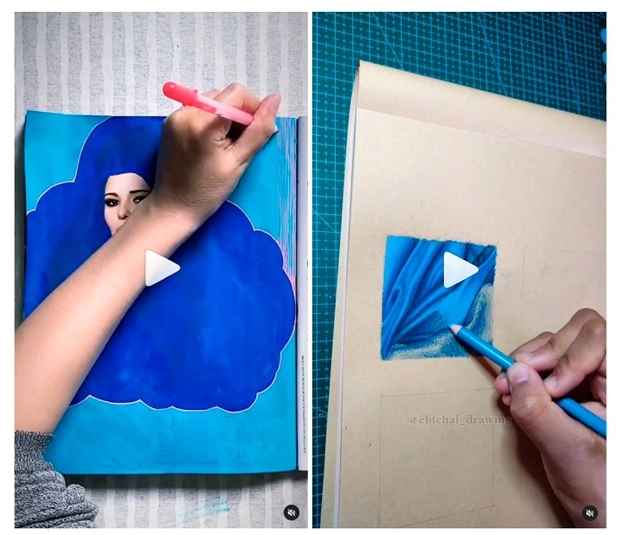
    A series of famous visual artists, like Leonardo da Vinci, Paul Klee, or Maurits C. Escher, are said to have been left handers, and examples like these have contributed to the popular belief that left handedness was associated with a special artistic talent. Besides this anecdotal evidence, the somewhat limited scientific literature provides, at best, modest evidence in support of this claim. So, to investigate the postulated association, we conducted an observational study on the social media platform “Instagram” examining the hand preference of visual artists who share video clips (“reels”) of their artistic activities. We found that roughly 9% of the artists showed a left-hand preference, which is (statistically) comparable to the 10-11% expected for the general population. Also, the such identified left-handed artists did not attract more “likes” or “followers” than their right-handed counterparts. In summary, we do not find any indication that left handers are more talented for visual artistic activities.