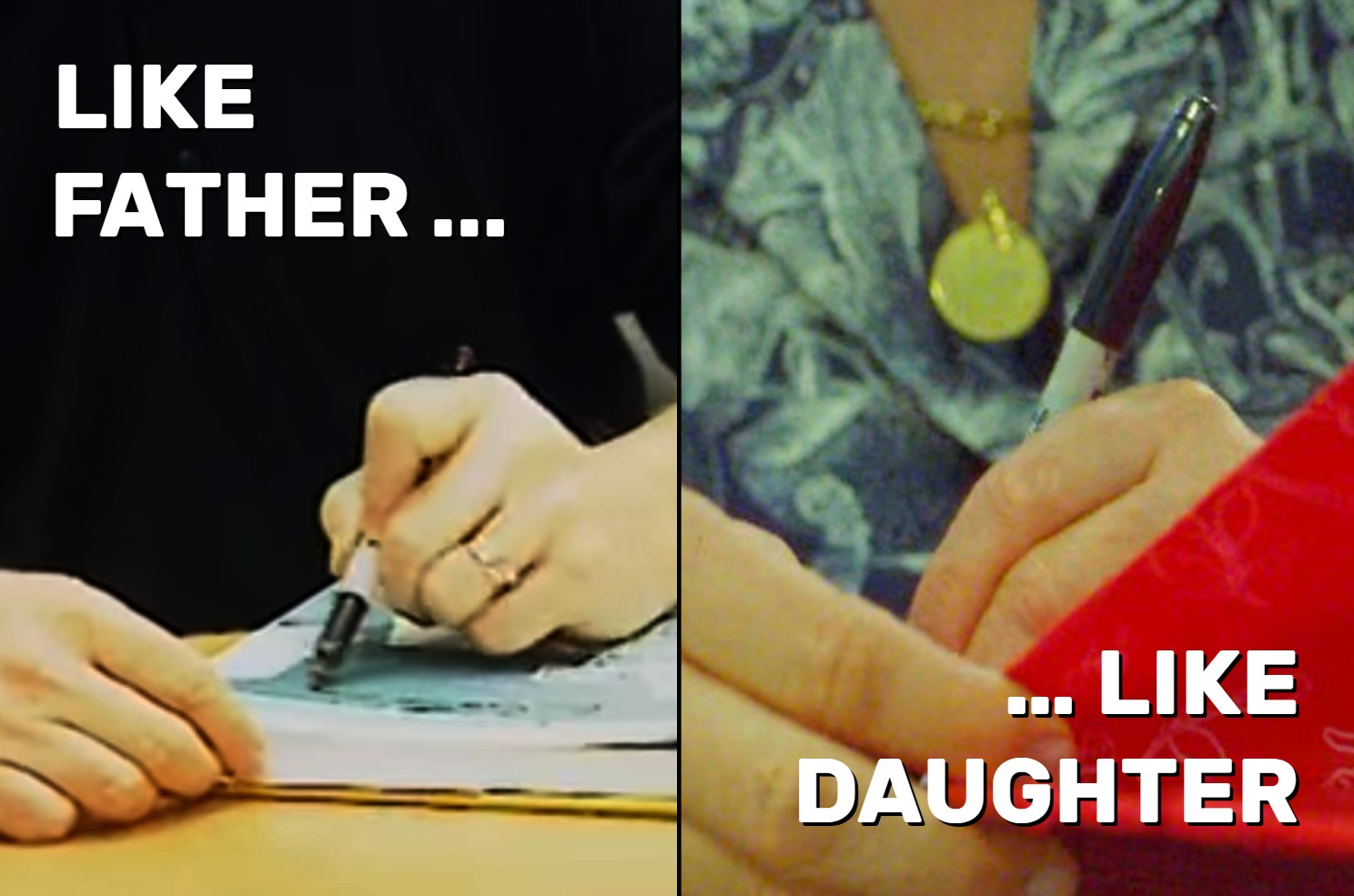
The post explores how likely it is for a left-handed parent to have a left-handed child, and vice versa. It turns out that both scenarios are surprisingly uncommon.
Mary McCartney, like her slightly better known Beatles-father Paul, prefers to write with her left-hand. From noticing this joint hand preference of parent and child, it is arguably tempting to conclude that the trait has been passed down the McCartney family tree. And, it appears rather likely that Mary quite often heard the phrase “You must have ‘it’ from your father” whenever her left-handedness became a topic, whether at home or elsewhere.
It is difficult, if not impossible, to evaluate whether this conclusion is specifically justified in the case to the McCartneys. However, examining left-handers as a group there is some evidence to the general notion that left-handers get more left-handed children.
A large-scale study including more than 72,000 children and their parents [1] found that two right-handed parents raise a left-handed child in about 9 out of 100 cases, while the number is roughly doubled to 19 out of 100, when one of the parents is a left-hander. In the rather rare case that both parents are left-handers, the odds are further increased to 26 out of 100 cases. These numbers clearly show that parental left-handedness increases the likelihood that the offspring will also be a left-hander.
Yet, an increased likelihood does not mean that left-handed parents necessarily get a left-handed child. No matter whether the family consists of one or two left-handed parents, the odds of having a right-handed child are still substantially higher than those of having a left-handed one. A right-handed child is three to four times more likely, to be precise.
We can also see these odds exemplified in the McCartney family. Mary has two full siblings, Stella and James, who both turned out to be right-handers, despite of having the same left-handed father, Paul, and right-handed mother, Linda [2]. So, two of three McCartney children did not inherit “it” from their father.
The above numbers, can even be used to estimate that most left-handed parents do not have a single left-handed child [3]. Considering the most common scenario with one left-handed parent, the likelihood of having at least one left-handed child exceeds 50% only if the couple has four or more children. For European, American, or Asian mixed-handedness couples, with an expected average of about two children per family [4], the chance is accordingly lower. Only one in three of these couples should, statistically, have a left-handed child.
These stats do also allow to answer the reversed question, so, whether a left-handed child is likely to have a left-handed parent. It can be calculated that this is not the case. While fully right-handed couples have a comparatively low likelihood of raising left-handers, they are also significantly more common than mixed- or fully-left handed couples. As a result by far most – or, roughly two out of three left-handers – are actually born to fully right-handed couples [5].
We have seen that parental handedness clearly matters. There is no scientific doubt that left-handedness runs in families and that a genetic disposition contributes to the inheritance of the trait [6]. But we also have to acknowledge that the effects of the inherited handedness “genes” are rather weak, leaving room for variations in how the trait unfolds during a child’s development.
As a result, and somewhat counter-intuitively, left-handed parents have mostly right-handed children, and left-handed children have mostly right-handed parents. And when it comes to handedness – as likely in many other respects – the McCartney family is not prototypical. A left-handed parent with a left-handed child is much rarer then one might intuitively believe.
[1] see Table 1a in McManus, I.C. & Bryden, M.P. (1992). The genetics of handedness, cerebral dominance, and lateralization. In: Boller, F., Grafman, J., editors. Handbook of Neuropsychology, Vol. 6 (pp. 115-143). Amsterdam: Elsevier.
[2] A quick online search reveals photos and videos of Stella and James McCartney using their hands in various situations. For example, James plays the guitar right-handed and signs autographs with his right hand, while Stella sketches her designs with a pen in her right hand. The same applies to their late mother Linda, who used to sign her photographs with her right hand.
[3] Using the estimates from McManus & Bryden (1992, see [1]) the probability for a mixed-handed couple to have a right-handed child is 0.81. For a sequence of n birth, it can be calculated as 0.81n, so for the second child (n=2) it is 0.81*0.81 = 0.66, for n=3 it is 0.53, and for n=4 it is 0.43, and so on. That is, from the 4th child onward the likelihood is below 50% that all children are right-handed, and it exceeds 50% for that at least one of the children is left-handed. So, only if all existing couples would have four or more children, we could reasonably expect that the majority of these couples had at least one left-handed child. For two right-handed parents this threshold is reached at n=8, assuming a base probability of 0.91 that a child is right-handed. For two left-handed parents, this threshold is already reached as n=3 (base: 0.74), these couples are, however, quite rare (ca. 1%; see [5]).
[4] see e.g. fertility rate data rates at gapiminder: https://www.gapminder.org/tools
[5] Assuming that about 11% of humans are right-handers, one may estimate that about 79% of all couples are made up of two right-handers (0.89 * 0.89 = 0.79), while about 20% include one left-hander (either the man or the women, so 0.11 * 0.89 + 0.89 * 0.11 = 0.196), and only 1% consistent of two left handers (0.11 * 0.11 = 0.012). Further assuming identical fertility of all couples and using the estimates from [1] one can do the following thought experiment: of 1000 children 790 (or 79%) are born to two right-handed parents of which 71 (9%) would turn out to be left-handers; 196 have one left-handed parent, giving rise to about 37 (19%) left handers among them; and 12 have two left-handed parents giving rise to 3 (26%) left-handers. So, of 111 left-handers of the offspring generation about 71, or 64%, do not have any left-handed parent. A good majority of the left-handers has only right-handed parents.
[6] see review by Paracchini, S. (2021). Recent advances in handedness genetics. Symmetry, 13(10), 1792; https://doi.org/10.3390/sym13101792