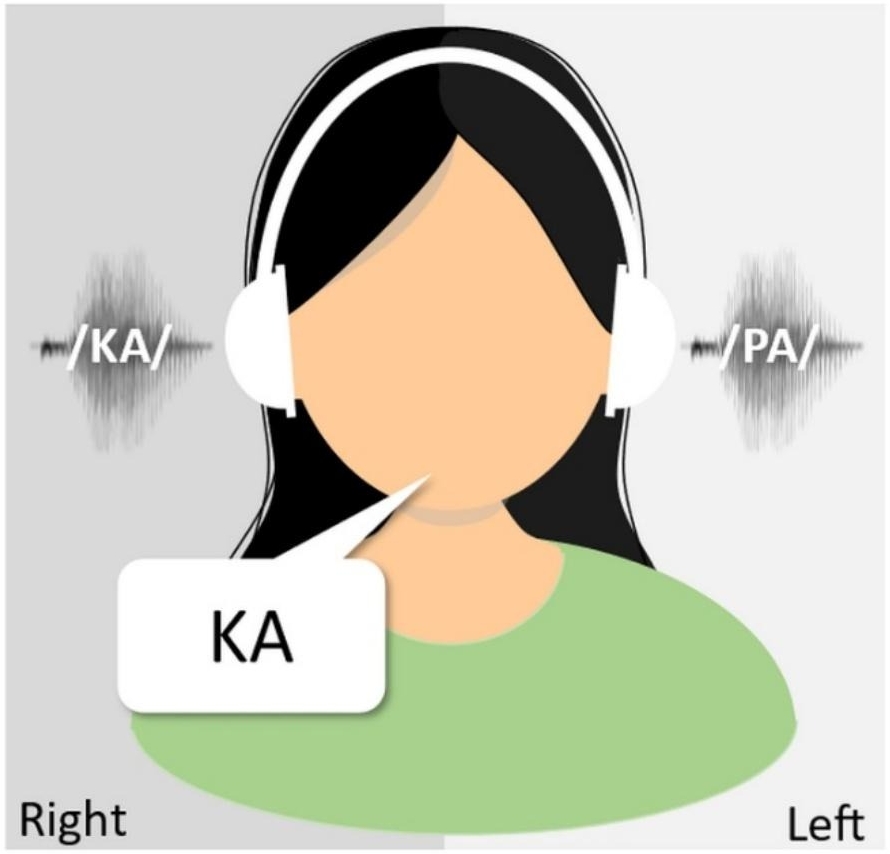
The article provides a brief introduction to dichotic listening with helpful links for interested researchers and curious others.
Dichotic listening is a classical test used by neuropsychologists to determine a person’s brain lateralisation for language functions. Its main appeal is that it is suitable in almost all settings as it is accessible to participants of all ages and abilities. The used speech stimuli are very simple and the instructions are easily understood and followed. Yet, despite its simplicity, the paradigm is a powerful tool to learn about the brain’s functional organisation.
At the core of the paradigm is the dichotic presentation: two sounds are presented simultaneously via headphones (as shown in the cartoon above), with one sound being played to the left ear and the other one to the right ear.
Various stimulus sounds have been used by researchers. My favourite version uses short consonant-vowel syllables, like Ka and Pa. These syllables are acoustically very similar to each other, and participants often believe they hear only one stimulus, even though two different stimuli are presented. So, when asked to report what they heard, participants typically just report one of the two stimuli.
Importantly, however, the reported stimulus is more often the stimulus played to the right ear than the one played to the left ear. This phenomenon is called the right-ear advantage and is linked to how, or better, where the brain typically processes speech and language.
In most people, speech processing is primarily a function of the left hemisphere, while only in small minority of the population (about 15%) the opposite is the case. We know this from clinical observations, where identifying the location of language processing is essential; for example, when planning brain surgery. Here, the location of the brain’s language centers has traditionally been determined by briefly anaesthetising one hemisphere at a time. If the anaesthesia prevents the patient from speaking, the “sedated” hemisphere is obviously the one responsible for speech processing.
Intriguingly, studies in the 1960s [1], that were conducted on these patients, showed that those with left-hemispheric dominance for language also prefer to report stimuli from the right ear when tested with dichotic listening. Reversely, those with dominance of the right hemisphere, preferred the left-ear stimuli. The hemisphere opposite to the preferred ear, was the one dominant for language. That is, the ear preference shown in dichotic listening was a pretty good predictor of which hemisphere was processing language in these patients.
But, how could this oddly “crossed” association be explained? One influential theoretical model [2] explains this by pointing out that each ear is predominantly connected to the opposite hemisphere. So, if the relevant language centers are, as typically is the case, located in the left hemisphere, the stimulus from the right ear will be the first to get access to language processing. This “first” stimulus will consequently dominante the subjective perception, which leads to the right-ear advantage. For a comprehensive discussion of this model and competing theoretical explanations can be found in an article published a few years ago [3] (which can be found here).
Today, dichotic‑listening paradigms are widely used to determine which hemisphere supports language processing. However, over the six decades since the paradigm was first introduced, numerous versions of the paradigm have emerged, and not all are equally suitable for this purpose. Design choices – such as the type of stimuli, the number of trials, or the instructions given – can substantially influence the outcome. At the same time, the extensive body of evidence that is available can be used to inform on how to design an optimal paradigm. A guide to support researchers in designing their own dichotic‑listening protocols has recently been published [4](and can be found here).
Naturally, we also designed an own optimal version of a dichotic-listening paradigm following these guidelines [5] (link). The empirical testing of the paradigm looked promising suggesting an excellent reliability. The paradigm (EPrime version) and stimulus material can be downloaded from the accompanying OSF page (here). It also includes some additional recommendation concerning the testing equipment as well as the data collected when first testing the new paradigm.
[1] Kimura, D. (1961). Cerebral dominance and the perception of verbal stimuli”. Canadian Journal of Psychology.,15(3), 166–171. https://psycnet.apa.org/doi/10.1037/h0083219
[2] Kimura, D. (1967). Functional Asymmetry of the Brain in Dichotic Listening. Cortex, 3 (2), 163–178. https://doi.org/10.1016/S0010-9452(67)80010-8
[3] Westerhausen, R. & Kompus, K. (2018). How to get a left-ear advantage: A technical review of assessing brain asymmetry with dichotic listening. Scandinavian Journal of Psychology, 59 (1): 66–73. https://doi.org/10.1111/sjop.12408
[4] Westerhausen, R. (2019). A primer on dichotic listening as a paradigm for the assessment of hemispheric asymmetry. Laterality, 24(6), 740–71. https://doi.org/10.1080/1357650X.2019.1598426
[5] Westerhausen, R., & Samuelsen, F. (2020). An optimal dichotic-listening paradigm for the assessment of hemispheric dominance for speech processing. PLoS ONE, 15(6), e0234665. https://doi.org/10.1371/journal.pone.0234665