By examining the handedness of acclaimed architects the post explores the popular belief that left-handers posses a greater artistic talent than right-handers.
Reading popular‑science articles, blog posts, or online discussions about left‑handedness, one regularly comes across the claim that left‑handers possess a special talent for artistic expression. Ask your favourite generative‑AI chatbot, and you will readily be informed that left‑handers are thought to be over‑proportionally often found in the “creative fields” including visual art, music, or writing [1]. You might even get offered a list of names of supposed left-handed artists as examples for this creative left-handedness, with the likes of Leonardo da Vinci, Pablo Picasso, Vincent van Gogh, Jimi Hendrix, or Lady Gaga, topping that list [2].
While it is not entirely clear where this popular belief in “creative left-handers” originated, one root appears to stretch back to a series of studies examining the handedness of architects. Conducted in the 1970s and led by John Peterson, these studies reported that left-handers were surprisingly common at the Department of Architecture at the University of Cincinnati [3]. Instead of the roughly 10% prevalence expected in the general population, about 29% of the academic staff and 16% of the school’s students were reported to be left-handers. Even more intriguingly, the left-handed students were also more successful. The rate of graduation was about 10% points higher in left-handers than in their right-handed peers.
It is not really surprising that these astonishingly clear findings were taken as evidence for a special talent for architecture among left‑handers. Peterson’s observations were accordingly cited as a key evidence for the formulation of a general theory about human brain development [4]. It was argued that both being left‑handed and having a strong visual‑constructive imagination were the result of an accentuated maturation of the brain’s right hemisphere. This maturation, in turn, was hypothesised to be driven by unusually high prenatal levels of the hormone testosterone.
The validity of this theory has been seriously questioned ever since its conception. Yet, it offers a good story which at the time made it a quite influential theory. So, it is not unlikely that it helped cementing the idea of “creative left handedness” both in the heads of many scientists and, via journalists, also in the public mind.
Considering the handedness of architects, it must be noted, however, that most later studies that attempted to replicate Peterson’s findings failed to do so. And, when I first started looking into the topic early last year, the idea of an excess of left-handed architects was already standing on quite shaky fundaments. Nevertheless, curious, as I was, I decided to have another look at it and I set out to find left-handers among famous architects. I thought if left-handers were indeed predestined to pursue a career in architecture, they should be particularly well represented among the men and women who have left a lasting mark on our cities.
The very first name I typed into “google” was Sir Norman Foster, the British star architect. Even if you are not familiar with his name, I am certain you have come across one or two of his buildings. The Millennium Bridge in London, the renovated Reichstag with its modern glass dome in Berlin, or the 2 World Trade Center in New York, are some of the more famous examples. When watching the first documentary I found about him [5], it became quickly obvious – literally within the first shots – that Foster was sketching his ideas holding the pen in his left hand. And, after consulting some more online material, I was quite convinced, he was, in fact, a left-hander.
Spurred on by this surprisingly quick success, I typed in some other names that came to mind, and I soon landed on the Swiss architect duo Herzog and de Meuron, the minds behind the Elbphilharmonie in Hamburg orThe Bird’s Nest, the stadion built for the 2008 Summer Olympics in Beijing. While one, Jacques Herzog, was clearly right-handed, the other, Pierre de Meuron, was writing and cutting ribbons with his left hand. Bingo! Another left-hander among the famous architects!
It was at this point that I decided to approach my hunt for left-handed architects a bit more systemically. Rather than randomly picking the names of architects that popped to my mind – a source which I was aware would soon run dry – I decided to go into the winner lists of various prestigious architecture awards. I started with the Pritzker Architecture prize, which is sometimes referred to as the “Nobel prize for architecture”, but soon went on to include other national and international awards and prizes in my search for relevant names.
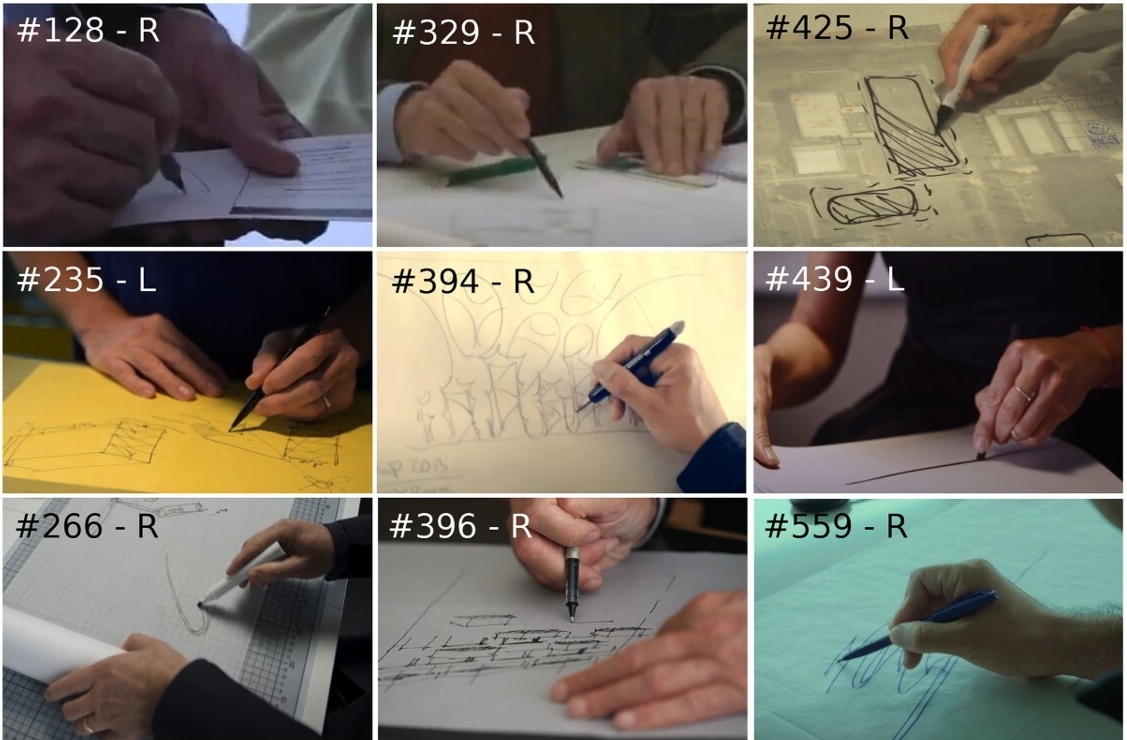
Armed with a set of winners list I began scouring the internet for videos and pictures showing the various architects while they were writing, sketching, or drawing, so I could determine their handedness. And about 600 architects later, I crunched the numbers. Here is what I found [6]:
Only 8% of the architects were left‑handers (or ambidextrous) which was below rather than above the 10% one would expect in the general population. In other words, left-handed architects, like Foster and de Meuron, were not more common than expected.
However, many of the architects on the winners lists had been born and grown up in times in which left-handers were subject to retraining. So, it was not possible to exclude that some members of my sample had been taught, against their inborn preference for the left hand, to write – and maybe also sketch – with their right hand. Ignoring this historical trend would obviously result in an underestimation of the amount of true left-handers in my sample. I had to make sure that this was not the case.
Since the 1950s retraining has gone increasingly out of fashion[7] and by selectively excluding architects born before 1950, it was possible to minimise the effect of retraining on my results. And, doing so, the incidence of left-handedness was indeed increased in this younger cohort. Nevertheless, the corrected rate of 10% did not differ statistically from the expected population rate. Left-handers were also not unusually frequent among the younger architects.
In short, it appears that Peterson’s results stand out as an exception. Being a left-hander instead of a right-hander does not really increase the likelihood for becoming a succesful architect.
Coming back to the common belief in the creative left‑hander, the finding chips away one likely root for this belief, while adding to a growing body of evidence disproving it [8]. Also outside architecture, left‑handers, seen as a group, are neither more creative than right‑handers nor over‑represented in professions commonly considered “creative”. That is, left-handers are likely as talented as right-handers to pursue a career in visual arts, music, design, writing, or architecture.
[1] Porac, C. (2025). ChatGPT: Tell me what you know about left-handedness. Retrieved August 11, 2025, from, https://sites.psu.edu/clarep/2025/01/17/chatgpt-tell-me-what-you-know-about-left-handedness/
[2] It can be questioned whether Pablo Picasso or Vincent van Gogh actually were left-handers at all. Both likely painted with their right hand. See Lanthony, P. (1995). Left-handed painters. Revue Neurologique, 151(3), 165–170, and in case of Picasso, video evidence for this is readily available online
[3] Peterson, J. M., & Lansky, L. M. (1974). Left-handedness among architects: Some facts and speculation. Perceptual and Motor Skills, 38(2), 547–550. https://doi.org/10.2466/pms.1974.38.2.547; and Peterson, J. M., & Lansky, L. M. (1977). Left-handedness among architects: Partial replication and some new data. Perceptual and Motor Skills, 45(3), 1216–1218. https://doi.org/10.2466/pms.1977.45.3f.1216
[4] Known as the Geschwind-Galaburda theory, which can be found on wikipedia.org: https://en.wikipedia.org/wiki/Geschwind-Galaburda_hypothesis
[5] Norman Foster: Striving for Simplicity, 2015, Louisiana Channel, https://youtu.be/hJNxgv9Rak0
[6] Westerhausen, R. (2025). Handedness of acclaimed architects: No indication for an over-proportional representation of non-right handers. Laterality, 30(2-6), 220-234. https://doi.org/10.1080/1357650X.2025.2569374
[7] McManus, I. C., Moore, J., Freegard, M., & Rawles, R. (2010). Science in the making: Right hand, left hand. III: Estimating historical rates of left-handedness. Laterality, 15(1-2), 186–208. https://doi.org/10.1080/13576500802565313; see also previous posts on retraining
[8] Meta-analysis by Morgan, O., Zhao, S., & Casasanto, D. (2025). Handedness and creativity: Facts and fictions. Psychonomic Bulletin & Review, 1–35. doi:10.3758/s13423-025-02717-2; or see: Røsvoll, Å., Rusten, E. H., & Westerhausen, R. (2024). Left-hand preference in visual artists: a pre-registered observational study on Instagram. Laterality, 29(2), 184-198. https://doi.org/10.1080/1357650X.2024.2315856 or post here